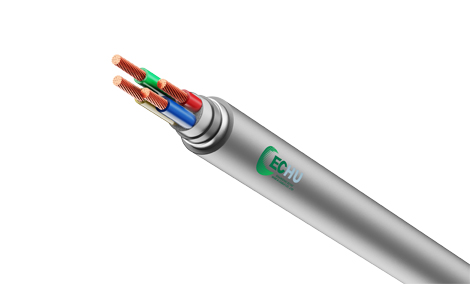

In automated equipment, communication reliability is a production KPI. When cables run inside drag chains, they face continuous bending, vibration, and torsion that can quickly damage shielding and conductors — leading to intermittent faults that are among the hardest problems in automation to diagnose. Choosing the right bus cable is one of the simplest ways to prevent data dropouts, reduce downtime, and stabilize fieldbus performance. This guide explains what to look for in data bus wire for constant-motion applications and how to specify a high-flex cable that survives real cycle life.
.png "/uploads/image/2026/05/07/bus cable(1).png")
A production line stops. The PLC logs a communication fault. Technicians swap connectors, check terminations, reboot devices — everything tests fine. The line restarts. Three days later, the same fault appears.
This is the signature of a fatigued data bus wire inside a drag chain. The failure is positional — it only manifests at specific points in the cable travel — and intermittent, which makes it invisible to standard cable continuity tests performed at rest.
| Symptom | Root Cause | Diagnostic Challenge |
|---|---|---|
| Random communication dropouts | Conductor strand breaks at fatigue point | Tests fine when the cable is stationary |
| Packet errors and CRC failures | Shield braid damage; increased EMI noise coupling | Appears as network-level error, not a cable fault |
| Noise spikes on signal lines | Broken shield; twisted pair geometry distorted | Oscilloscope needed to see; PLC logs only the result |
| Unstable servo or PLC feedback | Intermittent open circuit in motion | Loss of position data; safety-critical in some applications |
Every time the drag chain moves, the cable at the neutral bend radius point bends through the specified radius. At a modest 100 mm travel per second and a 500 mm travel distance, a cable makes approximately 12 million bend cycles per year. At that rate, a cable not designed for continuous flexing will fail — it is a question of when, not whether.
"Flexible" is a marketing term. "High-flex" in the context of drag-chain data bus wire has specific engineering meaning:
| Design Element | Standard Flexible Cable | High-Flex Cable |
|---|---|---|
| Conductor stranding | Class 5 fine stranding | Class 6 ultra-fine stranding or finer |
| Lay length | Moderate | Optimized for bending without conductor migration |
| Insulation compound | Standard PVC or polyethylene | Specialized flexible compound that maintains geometry under bending |
| Jacket compound | Standard PVC | PUR or high-flex PVC with good low-temperature properties |
| Shield construction | Standard braid | High-coverage braid or foil+braid optimized for flex without shield cracking |
| Rated cycle life | Not specified | Defined million-cycle rating at specified bend radius |
| Parameter | What to Define | Example |
|---|---|---|
| Minimum bend radius | The tightest bend the cable makes in the chain | 7.5 × cable OD for high-flex rated designs |
| Travel length | Total one-way travel distance per cycle | 1,200 mm |
| Travel speed | Maximum cable travel velocity | 3 m/s |
| Acceleration | Peak acceleration during motion | 5 m/s² |
| Cycle count | Expected cycles over machine service life | 10 million cycles over 10 years |
Fill ratio: total cable cross-section should not exceed 60% of chain cross-section — overfilling prevents free cable movement and accelerates fatigue
Cable separation: power cables and bus cables should be separated within the chain by a divider — direct contact transfers vibration and increases EMI coupling
Cable position: bus cables should be positioned at the neutral axis of the chain where possible to minimize bending stress
Fixation points: cable must be fixed at both the fixed and moving ends of the chain; intermediate fixation defeats the purpose of the energy chain
Signal integrity in a data bus wire is not just about shielding — it requires consistent electrical geometry throughout the cable's flex life.
| Electrical Property | What It Controls | Failure When Wrong |
|---|---|---|
| Characteristic impedance | Defines signal reflection at cable interfaces | Impedance mismatch causes reflections that corrupt data packets |
| Pair twist consistency | Differential mode noise rejection | Untwisted or inconsistent pairs pick up common-mode noise |
| Capacitance between conductors | Affects signal rise time and distance limit | Excessive capacitance limits maximum cable length for the protocol |
| Shield coverage | EMI rejection | Low-coverage braid creates gaps where noise couples in |
| Drain wire continuity | Shield grounding path | Broken drain wire under flex defeats the shielding system |
| Shield Construction | Flex Performance | EMI Protection | Best Application |
|---|---|---|---|
| Foil only | Good — foil flexes without cracking | Moderate — good at high frequency; gaps at low frequency | Low-EMI environments; shorter runs |
| Braid only | Moderate — braid coverage decreases under flex | Good — solid coverage when new | Moderate-cycle applications |
| Foil + braid | Best — foil maintains continuity; braid adds coverage | Excellent | High-EMI, high-cycle drag chain applications |
| Served (spiral) braid | Best flex performance | Good — consistent coverage through bending | Very high cycle count applications |
A data bus wire near a VFD-controlled axis is the most common scenario for EMI-induced communication failures. VFDs generate high-frequency switching transients that couple onto adjacent cables through both capacitive and inductive mechanisms. At a separation of 50 mm without a divider, coupling can be sufficient to corrupt data at high network speeds.
Physical separation within the energy chain and correct shielding grounding strategy — shield grounded at one end only for analog signals; both ends for digital buses — are the practical solutions.
A cable that is "shielded twisted pair" is not automatically compatible with your fieldbus. Each industrial communication standard defines specific cable requirements that directly affect signal quality and maximum network reach.
| Protocol Type | Key Cable Parameter | Consequence of Wrong Cable |
|---|---|---|
| RS-485 based (e.g., Modbus, Profibus DP) | 150 Ω characteristic impedance; defined capacitance | Wrong impedance causes reflections; reduces maximum segment length |
| CAN-based (e.g., CANopen, DeviceNet) | 120 Ω characteristic impedance; matched capacitance | Reflections cause error frames; network goes to error-passive state |
| Industrial Ethernet (e.g., EtherNet/IP, PROFINET, EtherCAT) | Cat5e equivalent; 100 Ω impedance; specified crosstalk limits | Excessive crosstalk causes packet errors; speed downgrade or link failure |
| Custom proprietary buses | Manufacturer-specified impedance and construction | Non-compliant cable may work initially but degrades before rated distance |
The most common source of fieldbus cable problems is the substitution of a physically similar but electrically non-compliant cable. The outer diameter, jacket color, and number of conductors may be identical — but the characteristic impedance, capacitance per meter, or pair geometry differs by enough to cause errors at full network length or under high-speed conditions.
Always request protocol-specific test parameters from the cable supplier — not just a "shielded twisted pair" description. For industrial Ethernet, request the Category rating and worst-case crosstalk data.
| Document | What It Confirms |
|---|---|
| Flex test report | Tested cycle count at rated bend radius without electrical failure |
| Characteristic impedance datasheet | Confirms protocol compliance within specified tolerance |
| Capacitance per meter | Confirms network length compatibility for your protocol |
| Braid coverage percentage | Confirms shielding effectiveness under flex |
| Temperature range | Confirms jacket compound performance at installation environment temperature |
| Oil and chemical resistance | Confirms jacket suitability for the machine environment |
| Test | Method | Pass Criteria |
|---|---|---|
| Continuity check | DC resistance measurement on all conductors and shield | Within specified resistance per 100 m |
| Insulation resistance | 500V DC megger between conductors and shield | Above specified minimum (typically greater than 100 MΩ) |
| Impedance check | TDR measurement | Within ±10% of specified characteristic impedance |
| Shield resistance | 4-wire measurement along full cable length | Confirms braid continuity and coverage quality |
The most effective risk reduction strategy for a bus cable specification is a pilot installation:
Install the new cable on one machine axis that represents the most demanding motion profile
Connect a network diagnostic tool to monitor packet error rate and retry count — not just pass/fail
Run the machine at production speed for a defined endurance period (typically 30–90 days)
Confirm error rate is stable and low before approving the cable specification for fleet deployment
Data faults caused by cable fatigue are among the most expensive small problems in automation — intermittent, hard to diagnose, and disruptive to production when they recur. Selecting a true high-flex bus cable built for drag-chain motion and validated for your fieldbus protocol can prevent these errors, reduce troubleshooting time, and improve machine uptime measurably. The best data bus wire choice matches both the mechanical cycle life of your application and the signal integrity requirements of your communication standard.
Q1: What is a bus cable used for in industrial automation?
A bus cable carries communication signals between PLCs, servo drives, sensors, and distributed I/O modules using a fieldbus or industrial Ethernet protocol. In constant-motion applications, it must do this reliably through millions of bending cycles inside drag chains or energy chain systems.
Q2: Why does data bus wire fail inside drag chains?
Continuous bending at the same point in the cable travel cycle concentrates fatigue stress at specific locations. Fine conductor strands break progressively, shield braid coverage decreases, and insulation compounds crack — each change increasing electrical noise and eventually causing communication errors that appear intermittent when the cable is tested at rest.
Q3: How do I determine the correct minimum bend radius for my drag chain application?
Use the cable manufacturer's specified dynamic minimum bend radius — not the static bend radius, which is significantly tighter. Match this to the inside radius of your energy chain. As a starting point, high-flex bus cables for drag chains typically specify a dynamic minimum bend radius of 7–10 times the cable outer diameter.
Q4: Does a bus cable inside a drag chain always need shielding?
In most industrial automation environments — particularly near VFD-controlled motor axes, servo systems, or switching power supplies — shielding is necessary to maintain signal integrity. Foil plus braid construction provides the best combination of flex performance and EMI protection for high-cycle drag chain applications.
Q5: What information should I provide to select the correct bus cable for my application?
Protocol type and version, required cable length, drag chain travel distance per cycle, minimum bend radius in the chain, travel speed and peak acceleration, expected total cycle count over the machine service life, installation environment temperature range, and any exposure to oil, coolants, or chemicals that affects jacket specification.


 English
 ไทย
ไทย tiếng việt
 हिंदी
हिंदी Jawa
Jawa