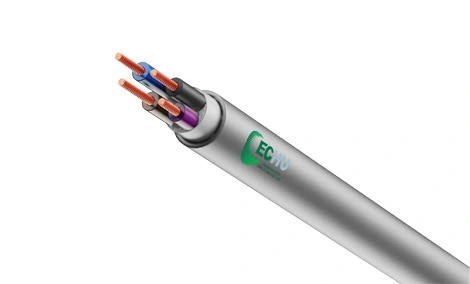

Overhead cranes depend on a reliable electrical connection to keep hoists, trolleys, motors, brakes, and control systems operating as the equipment moves across the working area. Unlike fixed electrical installations, these systems must accommodate repeated travel, bending, mechanical stress, and demanding industrial conditions. Cable selection therefore needs to consider both electrical performance and the way the cable behaves throughout the crane's operating cycle.
For most projects, selecting the right crane power cable should begin with four questions: What voltage and current must the cable carry? How will the cable move? What mechanical and environmental stresses will it encounter? How will it be supported or guided? A suitable crane cable wire should satisfy all four requirements rather than being selected only by conductor size or price.
A crane power cable provides electrical power and, depending on the cable design, may also carry control or signal circuits between fixed electrical equipment and moving crane components. Typical connected equipment can include hoist motors, trolley drives, brakes, limit switches, control devices, and other electrical systems installed on the bridge or trolley.
The key difference between crane cabling and ordinary fixed wiring is movement. As the trolley travels along the bridge or the crane moves along the runway, the cable may repeatedly bend, hang, travel through a festoon system, or wind onto a reel. This movement creates mechanical loads that must be considered together with normal electrical requirements.
Different crane designs therefore require different cable constructions. Flat flexible cables are commonly considered for festoon arrangements, while round cables may be used where suspension, tensile support, or another cable-management method is required. Reeling systems need cables designed to tolerate repeated winding and unwinding. Shielded constructions may also be selected where electrical interference needs additional control.
ECHU offers cable solutions for moving industrial equipment, including flexible flat crane cables, shielded cables, round flexible cables with supporting elements, and reeling cable constructions. Buyers planning a new overhead crane or replacing an existing cable can first review the wider ECHU cable product range and then narrow the selection according to the actual crane configuration.
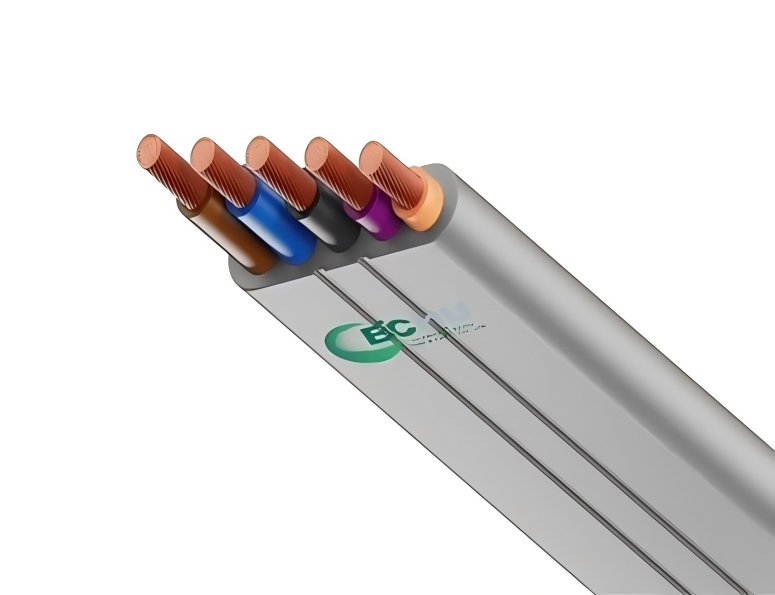
Choosing a crane power cable requires more than checking conductor size. Electrical rating, movement pattern, installation method, environmental exposure, and expected mechanical load should all be evaluated before the final specification is confirmed.
Electrical requirements come first. The cable voltage rating must match the electrical system, while conductor cross-section should be selected according to operating current, installation conditions, allowable voltage drop, thermal conditions, and applicable electrical requirements. Using a conductor simply because it was installed on a similar crane can create unnecessary risk if the actual load or installation arrangement is different.
Flexing and movement are equally important. A cable used in a festoon system experiences a different type of bending from one used on a cable reel. Travel distance, movement frequency, acceleration, suspension points, and direction of bending all influence cable behaviour. A flexible cable that performs well in one type of motion may not be appropriate for another.
Mechanical loads also need attention. Depending on the crane design, a crane cable wire may be exposed to its own hanging weight, pulling force, vibration, abrasion, or repeated bending. Where additional tensile support is needed, a cable with suitable supporting elements may be preferable to placing excessive load on the electrical conductors.
Environmental conditions should be reviewed before choosing the sheath material. Crane cables may operate in factories, warehouses, workshops, ports, processing plants, or outdoor handling areas. Exposure to oil, moisture, abrasion, chemicals, heat, low temperature, or sunlight can affect the suitability of a particular cable construction.
Finally, assess whether shielding is required. Where power circuits, motor cables, and signal or control circuits are installed close together, electromagnetic interference may need to be considered. A shielded crane cable can be useful in applications where system design requires additional electromagnetic compatibility.
The most practical way to match a cable to an overhead crane is to start with the cable-management method. The way the cable moves often determines which cable construction is most appropriate.
| Cable Type | Typical Cable Movement | Key Selection Factors | Typical Application Considerations |
|---|---|---|---|
| Flat flexible crane cable | Festoon or suspended travelling system | Flexibility, loop formation, conductor arrangement, sheath durability | Bridge cranes, trolley systems, electric hoists |
| Round flexible cable with supporting element | Suspended or vertically supported movement | Tensile load, cable weight, support method, flexibility | Systems where cable weight needs additional mechanical support |
| Flexible reeling cable | Repeated winding and unwinding | Reel geometry, tensile force, bending behaviour, winding method | Long-travel cranes and mobile industrial equipment |
| Shielded flexible crane cable | Festoon, suspended, or other compatible movement | EMC requirements, grounding, shielding structure, flexibility | Applications combining power and interference-sensitive circuits |
For a festoon system, the cable needs to form controlled loops between carriers as the trolley travels. A flat crane power cable is frequently used because its geometry can work well with organised suspended movement. However, the actual choice still depends on carrier design, loop depth, available space, cable weight, and the manufacturer's minimum bending requirements.
For a cable reel, the operating conditions change significantly. The cable is repeatedly wound onto and released from a drum, so it must be designed for the bending and tensile forces produced by this movement. An ordinary flexible cable should not be assumed to be suitable simply because it can be bent by hand.
The electrical configuration must then be matched to the mechanical design. Buyers should confirm conductor size, number of cores, voltage, control requirements, shielding needs, cable length, and termination method. If the crane cable wire carries both power and control functions, conductor arrangement and electromagnetic compatibility may require additional attention.
Providing detailed application information allows the cable supplier to make a more useful recommendation. Instead of asking only for "a cable for an overhead crane," buyers should describe how the crane moves, how the cable is supported, the required travel distance, electrical load, working environment, and any special mechanical requirements.
Correct installation has a major influence on cable service performance. Even a properly selected crane power cable can suffer premature damage if it is twisted, crushed, excessively stretched, or forced around an unsuitable bending radius.
Before installation, verify that the cable specification matches the crane electrical drawings and intended cable-management system. The cable, carriers, clamps, reels, supporting hardware, and termination points should all be inspected before work begins. Installation should be completed by qualified personnel under appropriate electrical and machinery safety procedures.
During cable payout, avoid introducing torsion. The cable should be unwound in a controlled manner rather than being pulled sideways from a reel in a way that creates loops or twists. Torsion introduced during installation may later cause uneven movement or additional stress when the crane begins operating.
In a festoon system, the cable loops should have enough space to travel without rubbing continuously against crane structures or adjacent cables. Carriers and clamps should support the cable securely while avoiding excessive compression of the outer sheath.
The required bending radius must also be respected. There is no single bending-radius value that applies to every crane cable wire. Cable diameter, conductor construction, sheath design, movement type, and manufacturer specifications all influence the permitted radius. The product technical data should therefore be checked rather than relying on a generic rule.
For reeling applications, reel diameter, cable guidance, pulling force, and winding arrangement should be compatible with the selected cable. Uneven winding or excessive tension can create unnecessary mechanical stress and shorten service life.
After installation, the crane should be observed through its expected travel range under controlled operating conditions where practical. Watch the cable as the trolley or bridge moves. It should travel smoothly without snagging, twisting, becoming excessively tight, or contacting sharp edges and nearby structures.
One of the most common mistakes is selecting a standard flexible cable without confirming whether it is designed for the required movement. General flexibility does not mean that a cable is suitable for continuous festoon travel, suspension, or reeling.
Another mistake is focusing only on conductor size and voltage. A crane power cable can be electrically suitable but mechanically unsuitable. Sheath properties, bending behaviour, tensile support, shielding, and cable-management compatibility should also be part of the selection process.
Incorrect bending is another frequent issue. Installing cables around undersized carriers, pulleys, or drums increases stress on the conductors, insulation, and sheath. The manufacturer's stated minimum bending requirements should be used during system design and installation.
Poor clamping can also create problems. If a clamp is too tight, it may deform the sheath or internal cable structure. If support is insufficient, the cable's own weight or movement force may be transferred to electrical terminations.
Excessive rubbing should not be overlooked. Repeated contact with steel edges, nearby cables, brackets, or other crane components can gradually damage the outer jacket. Cable routing should therefore minimise unnecessary contact throughout the complete travel path.
A final mistake is treating each cable as an independent component. In a crowded festoon system, several cables move together. Their size, weight, loop arrangement, and flexibility should be considered as one moving cable package to reduce tangling, interference, and uneven loading.
Preventive maintenance should focus on identifying mechanical or electrical changes before they become failures. Because a moving crane power cable operates under repeated mechanical stress, regular observation is particularly valuable.
Inspect accessible cable sections for abrasion, cuts, cracking, deformation, swelling, exposed internal elements, or abnormal twisting. Areas near carriers, clamps, reels, cable entries, and terminations deserve particular attention because these transition points often experience concentrated movement or mechanical load.
Cable behaviour should also be checked while the crane is moving. Festoon loops should open and close consistently, carriers should travel freely, and reeling cables should wind smoothly. A sudden change in the way a crane cable wire hangs or travels can indicate a problem with the cable, carrier, reel, guide, or supporting hardware.
Electrical terminations should remain secure and should not be used as mechanical support points. If significant cable damage is found, qualified personnel should evaluate whether replacement is required. A temporary external repair may not restore the original bending, tensile, or mechanical properties of a moving cable.
There is no universal replacement interval for every crane cable. Inspection and maintenance frequency should reflect operating intensity, crane duty, environmental conditions, equipment manufacturer recommendations, applicable safety requirements, and the facility's own preventive-maintenance programme.
Reliable cable performance on an overhead crane depends on matching the electrical specification to the actual movement and installation conditions. Voltage, operating current, conductor size, number of cores, flexing behaviour, sheath material, tensile support, shielding, environmental exposure, and cable-management method should all be considered before a final specification is approved.
The movement system is especially important. Flat flexible cables can be suitable for many festoon arrangements, supported round cables can address applications involving suspended cable weight, and dedicated reeling cables are intended for repeated winding and unwinding. Selecting the right crane power cable is therefore not simply a question of choosing a flexible cable with the correct conductor size.
Installation and maintenance are equally important. Correct routing, adequate support, controlled bending, reduced torsion, suitable clamping, and regular inspection help the crane cable wire perform as intended throughout the crane's operating cycle.
For projects where the correct construction is not immediately clear, providing detailed application information is the best starting point. ECHU can evaluate requirements such as voltage, conductor configuration, cable-management method, travel conditions, shielding needs, and environmental exposure. For project-specific cable selection or custom cable requirements, contact ECHU with your overhead crane specifications.
Overhead cranes may use flat flexible cables, round supported cables, shielded flexible cables, or reeling cables. The correct type depends on the crane's electrical requirements, movement method, cable-management system, and operating environment.
Not necessarily. A cable may be flexible but still be unsuitable for repeated festoon movement, suspension, or reeling. Its construction must be compatible with the actual mechanical movement of the crane.
Neither is universally better. Flat cable is commonly suited to organised festoon systems, while round cable may be more appropriate for certain suspended, supported, or reeling installations. The cable-management method should guide the decision.
Conductor size should be based on operating current, voltage, circuit length, allowable voltage drop, temperature, installation conditions, equipment requirements, and applicable electrical rules. Crane lifting capacity alone is not enough to determine conductor size.
There is no single interval suitable for every crane. Inspection frequency should consider operating duty, environmental conditions, manufacturer recommendations, applicable safety requirements, and the site's preventive-maintenance programme.
Provide the system voltage, conductor sizes, number of cores, required cable length, movement method, travel distance, operating environment, shielding requirements, and any applicable technical or certification requirements. This information helps the supplier match the cable to both the electrical and mechanical needs of the crane.



 English
 ไทย
ไทย tiếng việt
 हिंदी
हिंदी Jawa
Jawa